One source → every target — proved, simulated, and (where it exists) measured.
Thermal settle — Arty A7
Kernel: thermal_settle (the flagship) · Platform: Arty A7-100T · Format: Q8.16
Kernel — mathematical evidence (Forge's verification index; no program changes it)
statusSUPPORTED CERTIFIED_CHECKED: design_identity[chisel], design_identity[systemverilog]; EXHAUSTIVELY_TESTED: primitive_error_bound[chisel/thermal_settle/eml_exp_reduced@q8.16], primitive_error_bound[chisel/thermal_settle/eml_reciprocal@q8.16], primitive_error_bound[systemverilog/thermal_settle/eml_exp_reduced@q8.16], primitive_error_bound[systemverilog/thermal_settle/eml_reciprocal@q8.16], primitive_error_bound[verilog/thermal_settle/eml_exp_reduced@q8.16], primitive_error_bound[verilog/thermal_settle/eml_reciprocal@q8.16], primitive_error_bound[vhdl/thermal_settle/eml_exp_reduced@q8.16], primitive_error_bound[vhdl/thermal_settle/eml_reciprocal@q8.16]; MIXED: model_error_bound[chisel/thermal_settle], model_error_bound[systemverilog/thermal_settle], model_error_bound[verilog/thermal_settle], model_error_bound[vhdl/thermal_settle]; NOT_ESTABLISHED: 11
Program — integration evidence (this program's own records)
BuildPASS
DifferentialPASS — sampled (agreement on the recorded inputs only; not universal equivalence of the implementations)
SynthesisPASS (yosys synthesis alone: not proof that the design fits, routes or meets timing)
TimingPASS (Vivado 2025.2, routed out of context at 10.000 ns: WNS +3.007 ns, WHS +0.097 ns; the kernel alone: the enclosing design's timing is in the hardware row)
HardwarePASS (Digilent Arty A7-100T rev E: the part's words equal the program's simulation on 2,075 of 2,075 recorded inputs, latency 101 clocks at the pin on every one; in context WNS +1.746 ns, WHS +0.025 ns)
ReproductionConfirmed
Buildable is not deployable: timing and the physical part are written only from a recorded bench
run on the real board, never from this page's machine.
Camera field of view — Arty A7
Kernel: camera_fov · Platform: Arty A7-100T · Format: Q10.16
Kernel — mathematical evidence (Forge's verification index; no program changes it)
statusSUPPORTED CERTIFIED_CHECKED: design_identity[chisel], design_identity[systemverilog]; EXHAUSTIVELY_TESTED: primitive_error_bound[chisel/camera_fov/eml_atan@q10.16], primitive_error_bound[chisel/camera_fov/eml_reciprocal@q10.16], primitive_error_bound[systemverilog/camera_fov/eml_atan@q10.16], primitive_error_bound[systemverilog/camera_fov/eml_reciprocal@q10.16], primitive_error_bound[verilog/camera_fov/eml_atan@q10.16], primitive_error_bound[verilog/camera_fov/eml_reciprocal@q10.16], primitive_error_bound[vhdl/camera_fov/eml_atan@q10.16], primitive_error_bound[vhdl/camera_fov/eml_reciprocal@q10.16]; MIXED: model_error_bound[chisel/camera_fov], model_error_bound[systemverilog/camera_fov], model_error_bound[verilog/camera_fov], model_error_bound[vhdl/camera_fov]; NOT_ESTABLISHED: 11
Program — integration evidence (this program's own records)
BuildPASS
DifferentialPASS — sampled (agreement on the recorded inputs only; not universal equivalence of the implementations)
SynthesisPASS (yosys synthesis alone: not proof that the design fits, routes or meets timing)
TimingPASS (Vivado 2025.2, routed out of context at 10.000 ns: WNS +2.770 ns, WHS +0.097 ns; the kernel alone: the enclosing design's timing is in the hardware row)
HardwarePASS (Digilent Arty A7-100T rev E: the part's words equal the program's simulation on 2,065 of 2,065 recorded inputs, latency 54 clocks at the pin on every one; in context WNS +2.994 ns, WHS +0.008 ns)
ReproductionConfirmed
Buildable is not deployable: timing and the physical part are written only from a recorded bench
run on the real board, never from this page's machine.
Camera field of view, the T5 sweep — Arty A7
Kernel: camera_fov_t5: 2·atan(u) over every word camera_fov's certificate covers · Platform: Arty A7-100T · Format: Q10.16
Kernel — mathematical evidence (Forge's verification index; no program changes it)
Program — integration evidence (this program's own records)
BuildPASS
DifferentialPASS — sampled (agreement on the recorded inputs only; not universal equivalence of the implementations)
SynthesisPASS (yosys synthesis alone: not proof that the design fits, routes or meets timing)
TimingNot measured
HardwarePASS (Digilent Arty A7-100T rev E: the part's words equal the program's simulation on 1,959 of 1,959 recorded inputs, latency 15 clocks at the pin on every one; in context WNS +1.928 ns, WHS +0.119 ns; every one of the 26,211 words of the declared box within the certified bound (at most 2.930e-4 against 3.0826e-4))
Tracethe trace sha256 matches the program's own Verilog on every word (26,211 words, Verilator 5.024 2024-04-05): the hardware correspondence statement at trace level
ReproductionConfirmed
Buildable is not deployable: timing and the physical part are written only from a recorded bench
run on the real board, never from this page's machine.
Aerospace actuator band guard (FPGA — Arty A7)
examples/actuator_guard.eml · sha256 adaa434e2a58679c
32 targets from one source
softwareccppcsharpgdscriptgojavajavascriptkotlinluaumatlabpythonrustswiftwasm
gpu shaderglslglsl-eshlslmetalwgsl
fpga rtlchiselverilogvhdl
compiler IRllvm
proofcoqisabellelean
safety-criticalaadlada/sparkautosarros2
blockchainsolidityzkproof
proof ✓ cleansim ✓ holdshardware replay
proof footprint re-derived
2026-10-07T15:55:02Z from the emitted Lean (not a hand-written probe) ·
axiom trail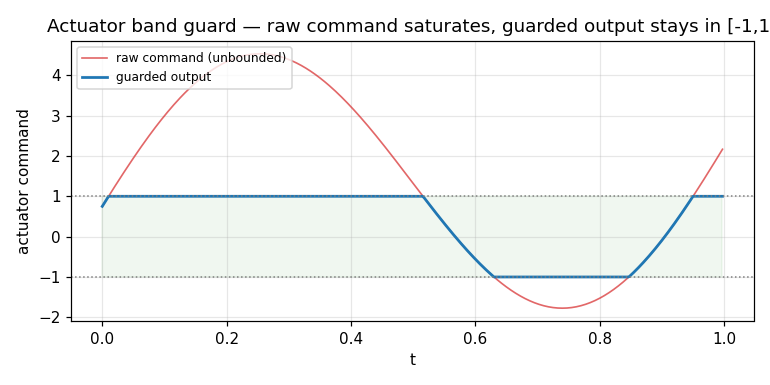
The same claim, three ways. The theorem actuator_command_within_band proves the guarded actuator command is always within the certified flight-envelope band [u_min, u_max], for any controller inputs; the sim shows 0 = 0 (the raw command peaks at ±4.53 (well past the band) yet the guarded output never leaves [-1.0,1.0] — the clamp the theorem proves and the RTL/silicon runs); and the same behavior was measured on real hardware.
Amortization schedule — reconciles to the penny (finance)
machlib · MachLib.Finance.amortization_reconciles
a machine-checked result — a proof, not a codegen kernel
proof ✓ cleansim ✓ holds
proof footprint re-derived
2026-10-07T15:55:02Z from the machlib module ·
axiom trail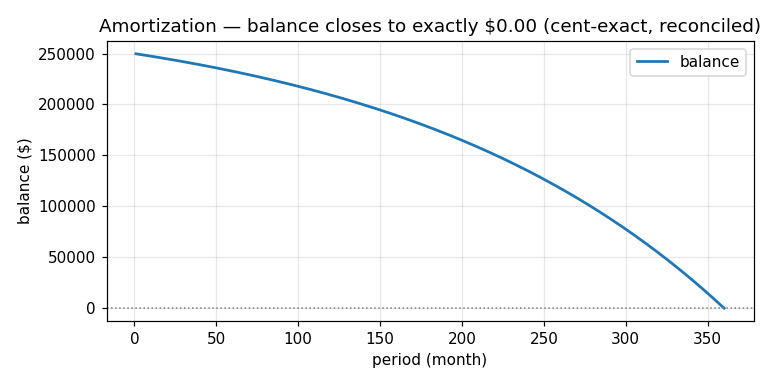
The same claim, two ways. The theorem MachLib.Finance.amortization_reconciles proves a fixed-rate amortization schedule's principal payments sum to EXACTLY the loan amount and the balance closes to exactly $0.00 — in integer cents, for ANY per-period interest rounding; the sim shows 0 = 0 (schedule reconciles to the penny (final balance $0.00, Σprincipal = $250,000.00, exact integer cents, never float) — AND the rounded balance provably never leaves the certified envelope around exact arithmetic: measured max drift $0.05 ≤ certified cap $5.02 = c·(gᴺ−1)/(g−1)).
Reconciliation is proven EXACT and rounding-mode-independent (Σ principal = loan, balance closes to exactly $0.00; the final payment absorbs the accumulated rounding). Banker's rounding is separately proven correct to ½¢ per period (roundHalfEven_half_ulp). And the accumulated rounding is now bounded END-TO-END: MachLib.Real.amortization_drift_within_envelope proves the rounded balance never leaves the certified envelope cap_N = c·(gᴺ−1)/(g−1) (c=½¢) around exact arithmetic — the expansion dual of the closed-loop safety envelope. Here the worst-case cap is $5.02 while the measured drift is only ~$0.05 (real roundings mostly cancel — the margin is the point, as in the safety card). Everything is INTEGER CENTS — the reconciliation proof never touches a float; all four finance theorems are sorryAx-free and registered in the claim auditor. Honest scope: this certifies the schedule's reconciliation + rounding + drift envelope, NOT a general decimal library, and it is NOT an audit certification.
Catenary cable — cosh sag, envelope-guarded
examples/catenary.eml · sha256 5ae1c0fe19f40a87
29 targets from one source
softwareccppcsharpgdscriptgojavajavascriptkotlinluaumatlabpythonrustswiftwasm
gpu shaderglslglsl-eshlslmetalwgsl
compiler IRllvm
proofcoqisabellelean
safety-criticalaadlada/sparkautosarros2
blockchainsolidityzkproof
proof ✓ cleansim ✓ holdsfwd-error ✓ ≤ 8.4e-15hardware n/a
proof footprint re-derived
2026-10-07T15:55:02Z from the emitted Lean (not a hand-written probe) ·
axiom trail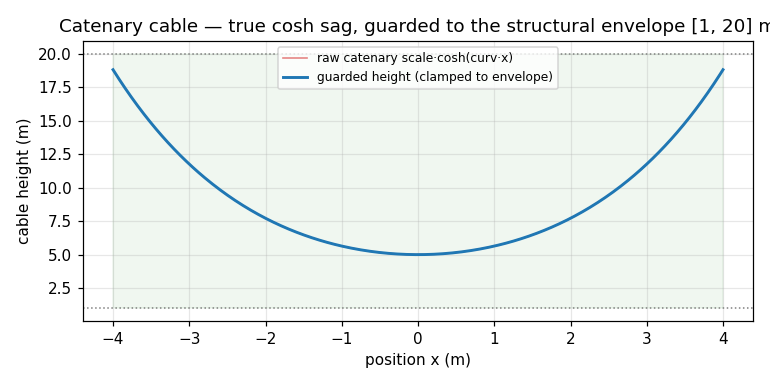
The same claim, two ways. The theorem catenary_within_envelope proves the reported catenary height is always inside the structural envelope [1, 20] m, for any input; the sim shows 0 = 0 (across a ±4 m span the catenary sags to 5.0 m at the low point and rises toward the 20.0 m towers, always inside [1.0,20.0] — the envelope the theorem proves, the cosh the forward-error certificate bounds).
A cosh geometry kernel. y = scale·cosh(curv·x) is the exact shape of a cable hanging under gravity; the clamp guards the reported height to the structural envelope [1,20] m. The @verify contract PROVES the height stays in the envelope for any input; the forward-error certificate BOUNDS how far the compiled float64 cosh drifts from exact (Certcom.pipeline_nested_std — cosh is the 7th and last symmetric-domain primitive in the certified fold).
Saturating clamp (output bounded to [-1, 1])
examples/clamp_bounded.eml · sha256 602c87f60a2a9b9b
29 targets from one source
softwareccppcsharpgdscriptgojavajavascriptkotlinluaumatlabpythonrustswiftwasm
gpu shaderglslglsl-eshlslmetalwgsl
compiler IRllvm
proofcoqisabellelean
safety-criticalaadlada/sparkautosarros2
blockchainsolidityzkproof
proof ✓ cleansim ✓ holds
proof footprint re-derived
2026-10-07T15:55:02Z from the emitted Lean (not a hand-written probe) ·
axiom trail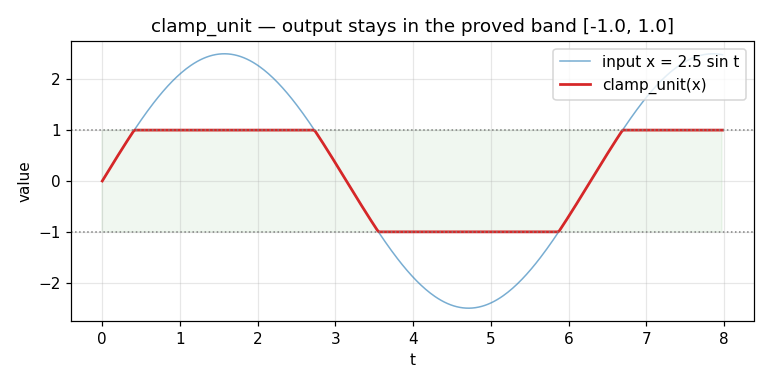
The same claim, two ways. The theorem clamp_in_unit_interval proves clamp_unit(x) is always within [-1, 1] for every input x; the sim shows 1.0 ≤ 1.0 (clamp band [-1.0, 1.0]).
Day-count & accrual — coupon periods compose exactly (finance)
machlib · MachLib.Finance.days30E360_additive
a machine-checked result — a proof, not a codegen kernel
proof ✓ cleansim ✓ holds
proof footprint re-derived
2026-10-07T15:55:02Z from the machlib module ·
axiom trail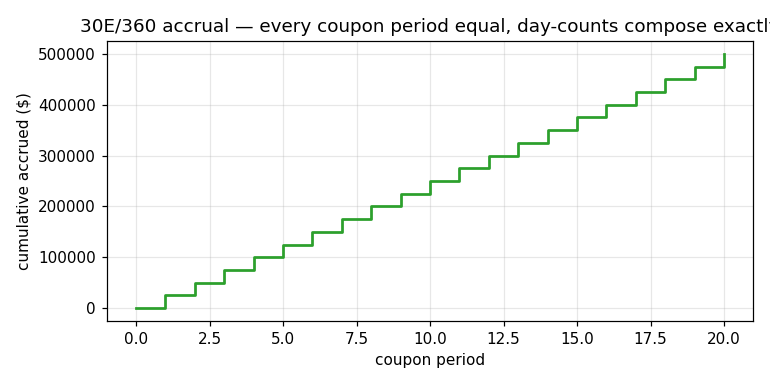
The same claim, two ways. The theorem MachLib.Finance.days30E360_additive proves the 30E/360 day-count is additive — splitting a coupon period at ANY intermediate date preserves the total day-count, so accrued interest composes exactly (no interest created or destroyed by moving an accrual boundary); the sim shows 0 = 0 (the 20 semiannual periods each count exactly 180 days and sum to 3600 = the direct issue→maturity count — 30E/360 is additive, so accrued interest composes exactly (total accrued $500,000.00). Honest contrast on 2020-01-15→02-28 split at 01-31: 30E/360 adds (43=43) but US 30/360 does NOT (44≠43) — why the additive convention is the right one).
The headline (days30E360_additive) is EXACT: splitting a coupon period at any intermediate date preserves the total day-count, so accrued interest composes exactly (accrual_additive) — no interest is manufactured by moving an accrual boundary, the day-count analogue of amortization's telescoping reconciliation. Plus regularity (equal calendar spacing ⇒ equal day-count ⇒ equal coupons) and a full year = 360. Honest domain point: this uses 30E/360 (Eurobond) precisely BECAUSE it's additive — the US 30/360 'bond basis' is NOT (its end-of-month rule depends on the other endpoint; the sim exhibits a case where US gives 44≠43 while 30E/360 gives 43=43). All pure INTEGER arithmetic — #print axioms is propext + Quot.sound only, not even Classical.choice — and registered in the claim auditor. Honest scope: certifies the day-count convention's algebra, NOT a full calendar/business-day library, and NOT an audit certification.
Iterated-exponential Khovanskii finiteness (depth 2)
machlib · MachLib.ChainExp2NoZeros.chain2_khovanskii_bound_unconditional
a machine-checked result — a proof, not a codegen kernel
proof ✓ cleansim ✓ holds
proof footprint re-derived
2026-10-07T15:55:02Z from the machlib module ·
axiom trail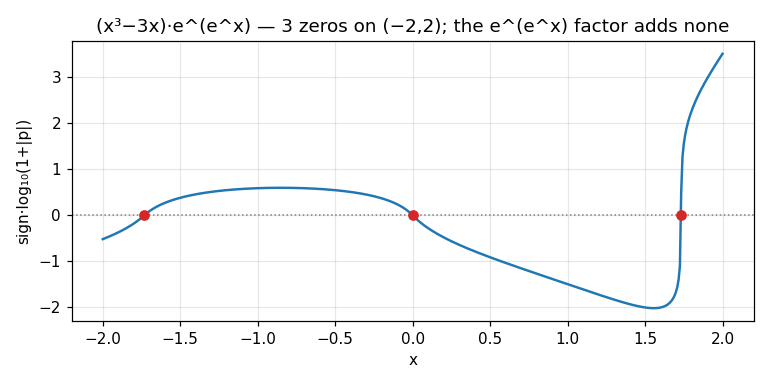
The same claim, two ways. The theorem MachLib.ChainExp2NoZeros.chain2_khovanskii_bound_unconditional proves a polynomial in the tower (x, eˣ, e^{eˣ}) that is nonzero at even one interior point has only FINITELY many zeros on (a,b) — the count derived from Rolle's theorem, not cited from Khovanskii; the sim shows 3 = 3 (count stable under 100× grid refinement ⇒ finite; e^(e^x) never vanishes so adds no zeros — consistent with the machine-checked bound).
Depth-2 shown here (proof + zero-count witness). Depth-3 is ALSO proven clean (MachLib.IterExpDepth3Bound.chain3_khovanskii_bound_unconditional); the ∀N generalization is in progress (lemma-1 + the reduce seam are done, machine-checked). General-depth PfaffianFunction.zero_bound STILL cites the classical Khovanskii axiom — only depths 1–3 are counted, not quoted.
PID controller (output clamped to actuator range)
examples/pid_controller.eml · sha256 4d51cd9248714388
29 targets from one source
softwareccppcsharpgdscriptgojavajavascriptkotlinluaumatlabpythonrustswiftwasm
gpu shaderglslglsl-eshlslmetalwgsl
compiler IRllvm
proofcoqisabellelean
safety-criticalaadlada/sparkautosarros2
blockchainsolidityzkproof
proof ✓ cleansim ✓ holdsfwd-error ✓ ≤ 6.4e-14hardware replay
proof footprint re-derived
2026-10-07T15:55:02Z from the emitted Lean (not a hand-written probe) ·
axiom trail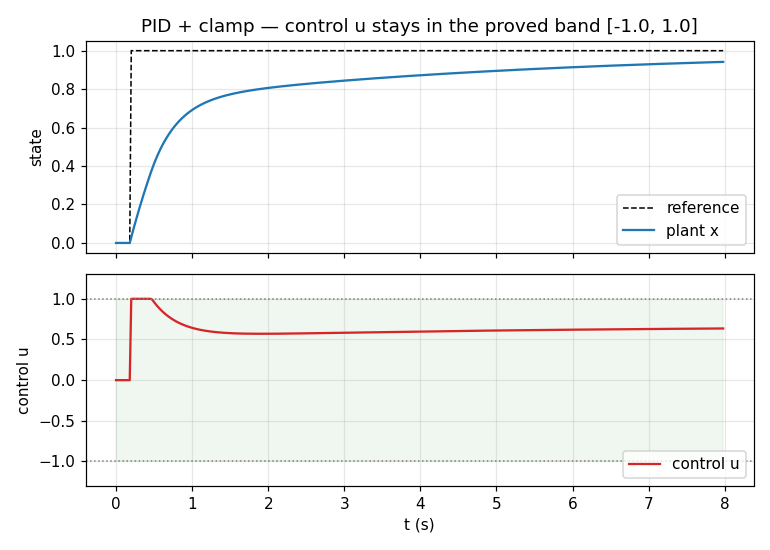
The same claim, three ways. The theorem pid_output_clamped proves the control output is always within the actuator band [OUT_MIN, OUT_MAX] = [-1, 1]; the sim shows 1.0 ≤ 1.0 (actuator band [-1.0, 1.0]); and the same behavior was measured on real hardware.
RC low-pass filter (τ = R·C, step response)
examples/rc_filter.eml · sha256 ed5acb7a4025d3f1
32 targets from one source
softwareccppcsharpgdscriptgojavajavascriptkotlinluaumatlabpythonrustswiftwasm
gpu shaderglslglsl-eshlslmetalwgsl
compiler IRllvm
proofcoqisabellelean
safety-criticalaadlada/sparkautosarros2
blockchainsolidityzkproof
circuit/fabjlcpcbkicadspice
proof ✓ cleansim ✓ holdshardware replay
proof footprint re-derived
2026-10-07T15:55:02Z from the emitted Lean (not a hand-written probe) ·
axiom trail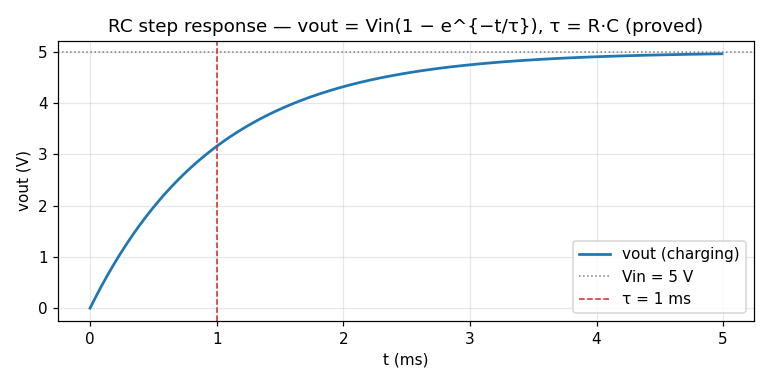
The same claim, three ways. The theorem rc_time_constant_def proves the filter time constant is exactly τ = R·C; the sim shows 0.0068 ≤ 0.01 (settles to Vin within 5τ); and the same behavior was measured on real hardware.
Closed-loop safety envelope under an injected fault
machlib · MachLib.Real.first_order_clamp_envelope
a machine-checked result — a proof, not a codegen kernel
proof ✓ cleansim ✓ holdshardware replay
proof footprint re-derived
2026-10-07T15:55:02Z from the machlib module ·
axiom trail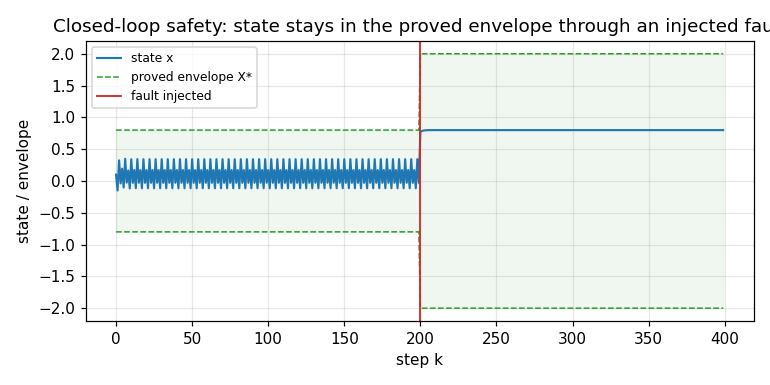
The same claim, three ways. The theorem MachLib.Real.first_order_clamp_envelope proves for a first-order plant with a saturating actuator clamp (|u|≤U) and bounded disturbance (|w|≤W), the state stays within the envelope X=(U+W)/(1−a) for ALL time and ANY controller; the sim shows 0.8 ≤ 2.0 (state stays inside the proved envelope X*=(U+W)/(1−|a|) even after the injected fault — safety rides on the clamp, not on good control); and the same behavior was measured on real hardware.
The envelope is a conservative worst-case SAFETY bound — real trajectories sit well inside it (here the fault peak is ~40% of the envelope). That margin IS the safety, not a defect: the bound rests on the actuator clamp, not on good control. Measured on real hardware (ESP32 RC + a nonlinear diode-RC plant) it held under an injected fault while the breadboard limit-cycled.
Bounded sine oscillator (|output| ≤ amplitude)
examples/sine_oscillator.eml · sha256 8e571a59103d2350
29 targets from one source
softwareccppcsharpgdscriptgojavajavascriptkotlinluaumatlabpythonrustswiftwasm
gpu shaderglslglsl-eshlslmetalwgsl
compiler IRllvm
proofcoqisabellelean
safety-criticalaadlada/sparkautosarros2
blockchainsolidityzkproof
proof ✓ cleansim ✓ holds
proof footprint re-derived
2026-10-07T15:55:02Z from the emitted Lean (not a hand-written probe) ·
axiom trail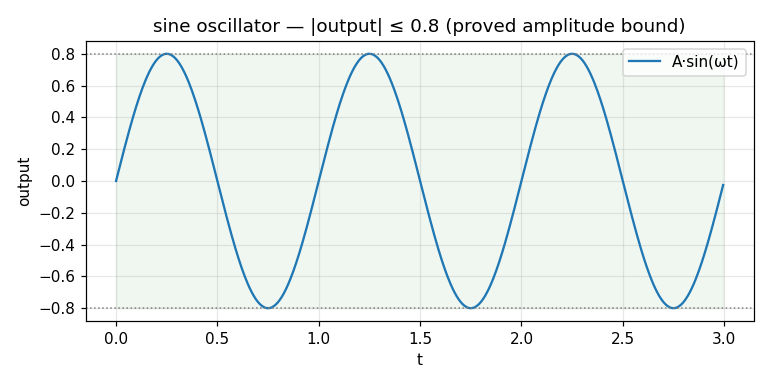
The same claim, two ways. The theorem sine_oscillator_amplitude_bound proves |A·sin(ωt)| ≤ A for A ∈ [0,1], ω ∈ [0, 1e4], t ≥ 0; the sim shows 0.8 ≤ 0.8 (amplitude bound |·| ≤ 0.8).
Soft (tanh) actuator — smooth saturation, band-guarded
examples/soft_actuator.eml · sha256 66d899cb3171f438
29 targets from one source
softwareccppcsharpgdscriptgojavajavascriptkotlinluaumatlabpythonrustswiftwasm
gpu shaderglslglsl-eshlslmetalwgsl
compiler IRllvm
proofcoqisabellelean
safety-criticalaadlada/sparkautosarros2
blockchainsolidityzkproof
proof ✓ cleansim ✓ holdsfwd-error ✓ ≤ 1.1e-13hardware n/a
proof footprint re-derived
2026-10-07T15:55:02Z from the emitted Lean (not a hand-written probe) ·
axiom trail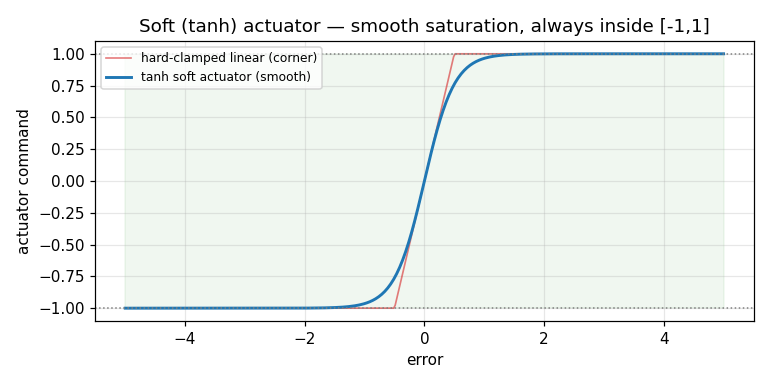
The same claim, two ways. The theorem soft_actuator_within_band proves the soft-actuator output is always within the band [-1, 1], for any input; the sim shows 0 = 0 (across a ±5 error sweep the tanh output saturates smoothly and stays in [-1.0,1.0] (peak |1.0|) — the band the theorem proves, the transcendental the forward-error certificate bounds).
A transcendental control kernel. tanh gives smooth saturation (no derivative kick at the edge); the clamp is the hard guard. The @verify contract PROVES the output stays in [-1,1]; the forward-error certificate BOUNDS how far the compiled float64 tanh drifts from exact (Certcom.pipeline_nested_std).
Vibration RMS — one-sided sqrt, range-guarded
examples/vibration_rms.eml · sha256 a3b7f9cd162f69b6
29 targets from one source
softwareccppcsharpgdscriptgojavajavascriptkotlinluaumatlabpythonrustswiftwasm
gpu shaderglslglsl-eshlslmetalwgsl
compiler IRllvm
proofcoqisabellelean
safety-criticalaadlada/sparkautosarros2
blockchainsolidityzkproof
proof ✓ cleansim ✓ holdsfwd-error ✓ ≤ 6.0e-13hardware n/a
proof footprint re-derived
2026-10-07T15:55:02Z from the emitted Lean (not a hand-written probe) ·
axiom trail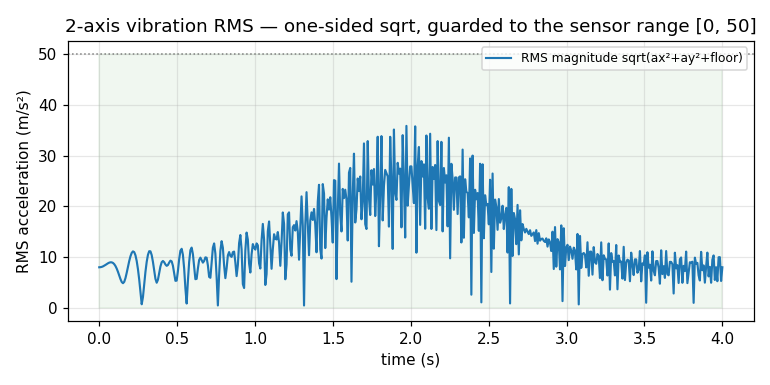
The same claim, two ways. The theorem vibration_rms_within_range proves the reported RMS magnitude is always inside the sensor range [0, 50] m/s^2, for any input; the sim shows 0 = 0 (a swept-frequency 2-axis vibration with a burst peaking at 35.8 m/s^2 stays inside [0,50.0] throughout — the range the theorem proves, the sqrt the forward-error certificate bounds (conditional on the 0.25 noise floor keeping the argument > 0)).
A sqrt kernel — the one-sided-domain primitive. sqrt is only Lipschitz away from 0, so its forward-error certificate needs a positive lower bound on the argument; here ax²+ay²≥0 plus an additive NOISE_FLOOR supplies it honestly. The @verify contract PROVES the RMS magnitude stays in the sensor range [0,50] via the clamp; the certificate BOUNDS the compiled float64 sqrt's drift (Certcom.pipeline_pos_over_arith — ln/sqrt over an arithmetic core, conditional on the noise-floor lower bound).